
Financial KPIs: KPIs That Every Growing Business Needs to Track in 2025

Financial KPIs function as a sort of a base, or rather a foundation, for making informed business decisions. Without having a clear understanding of which metrics you should track to measure performance, even the most promising companies can struggle to identify problems early, allocate resources effectively, or demonstrate upward progression.
In this blog, we’ll walk you through what financial KPIs are, which specific metrics matter most, and how to select the right ones for your business stage and goals.
What Are Financial KPIs and Why They Matter
We’re sure you already know at least something about them, but we’ll still cover the basics. Financial KPIs (Key Performance Indicators) are quantifiable measurements that track your company's financial health and performance against strategic objectives. Unlike general financial data, these are specifically chosen metrics that directly inform business decisions and measure progress toward goals.
Defining a useful KPI is tricky, as every business has its own key traits and characteristics. However, a useful financial KPI should have these four essential characteristics.
- It must be measurable in clear, trackable numbers so you can monitor changes over time.
- The metric should be relevant to your specific business model and current stage of growth.
- It needs to be actionable, meaning it informs specific decisions or adjustments you can make.
- It should align with your strategic objectives and business outcomes.
These metrics typically fall into several categories that each reveal different aspects of your business. Profitability metrics show how much money you actually keep. Liquidity metrics indicate whether you can meet short-term financial obligations. Efficiency metrics reveal how well you're using your resources and converting them from inputs into outputs. Growth metrics track your expansion and ability to scale operations.
Essential Financial KPIs by Category
Understanding which financial KPIs to track starts with understanding your business. Envision your goals and how they might be reflected upon on a weekly, monthly, and yearly basis. The right metrics depend heavily on your business model, but certain categories of financial KPIs prove valuable across most growing companies.
Revenue and Growth KPIs
It is often said that you can’t grow what you can’t measure, and we definitely agree. A business can’t sustainably grow based on faulty data or, even worse, gut feelings. These are some of the most common metrics that you should be tracking in terms of revenue and growth.
Monthly Recurring Revenue (MRR) measures the predictable revenue stream you can count on each month from subscription customers. If you’re not yet tracking your MRR and you’re a subscription-based provider, then this is probably the most important metric you need to track right now. Along with your standard MRR, there are also a few other types that fall into the MRR category, such as:
- New MRR (Generated by new subscribers)
- Reactivation MRR (Regained revenue from re-subscriptions)
- Expansion MRR (MRR that stems from tier upgrades, added features and so on)
The formula for calculating your MRR is pretty simple, but it’s a massively important factor in determining your operational health:
MRR = Total Number of Active Accounts × Average Revenue Per Account (ARPA)
Alternatively, you can also choose to multiply the number of active accounts by your Average revenue per User (ARPU), which is easily acquired by dividing your Total recurring revenue by the total number of users.
For early-stage SaaS companies, achieving 10-20% month-over-month MRR growth indicates strong momentum, while more mature companies typically target a stable 5-10% monthly growth. Alternatively, you can also track your ARR (Annual Recurring Revenue).
Revenue Growth Rate, simply put, shows the percentage change in revenue over a specific period. According to Harvard Business School's research on financial performance measures, understanding revenue trends helps managers significantly improve their decision-making process and career success. As with MRR, hungry venture-backed startups typically aim for higher percentages like 20-40% annual growth, while established companies often target 5-15%. A steady, positive growth rate indicates that your business is healthy, is potentially attractive to investors, and has a competitive market position. The formula for calculating it goes as follows:
RGR = ((Current Period Revenue - Previous Period Revenue) / Previous Period Revenue) × 100
Another important metric to track for subscription-based services is Churn Rate, which measures the percentage of customers who cancel or don't renew. This is calculated as:
(Customers Lost in Period / Customers at Start of Period) × 100
Tracking your churn rate is especially important to reflect your long-term success. If you’re on a very high churn rate, then it’s high time to rethink your strategy, adapt your model, or incorporate something to retain your existing customers.
Profitability KPIs
These are pointers that relate to your capability of generating income (profit). They reflect on your business’s health and your ability to consistently make profit where profit is available. Here are some of the most common markers of profitability:
Gross Profit Margin reveals what percentage of revenue remains after subtracting direct costs of delivering your product or service. Gross profit margin varies wildly from industry to industry, so expect some SaaS companies to target 70-85% gross margins, product businesses to aim for 40-60%, and service companies to fall somewhere in between at 50-70%. This financial KPI greatly demonstrates pricing power and whether your business model can scale profitably as you grow. To calculate your Gross Profit Margin, use this formula:
((Net Profit - Cost of Goods Sold) / Net Sales) × 100
Net Profit Margin shows the ultimate profitability measure by indicating what percentage of revenue becomes actual profit after all expenses. Keep in mind that, while it is one of the ultimate measures of profitability, relying on a single number in a document filled with them isn’t the most reliable practice. Healthy businesses typically achieve 10-20% net profit margins, though growth-stage startups often operate at negative margins while investing in expansion. This metric answers the fundamental question every business owner needs to know: after everything is paid for, are you actually making money? The formula for knowing your Net Profit Margin is:
(Net Profit / Total Revenue) × 100
Operating Profit Margin measures profitability from your core business operations before considering interest payments and taxes. It’s sometimes overlooked amongst the golden standards of Net/Gross Profit Margins, but it’s still a great KPI to track as it indicates how well your business is actually managed. It basically reveals whether your business model itself generates profit, independent of how you've chosen to finance the company or what tax jurisdiction you operate in. The formula goes as follows:
(Operating Income / Total Revenue) × 100
Cash Flow KPIs
Cash flow is, in essence, the amount of money flowing in and out of your business during a specific time period. It reflects on your ability to grow your business while also sustainably taking care of everything, from bills and due payments to other finances. Below are some of the standard financial KPIs you should be following in terms of Cash Flow.
Burn Rate tracks how much cash you spend each month, basically reflecting how much you’re losing each month. It’s one of the most important cash flow-related metrics, especially for startups seeking funding. As a striving startup, this metric should align with your runway targets and funding strategy. Research from SaaS Capital's 2025 benchmarking study shows that bootstrapped SaaS companies with $3M to $20M in ARR are increasingly focused on efficient spending, with many operating near breakeven or profitability to avoid dependency on external funding. Here’s how you can calculate your net burn rate:
(Monthly Revenue - COGS) - Gross Burn Rate
Runway (Cash Runway) indicates how many months of cash you have remaining at your current burn rate. Figuring out your Cash Runway is pretty easy:
Cash Runway = Cash on Hand / Burn Rate
Maintaining 12-18 months of runway provides a minimum safety buffer, while 24+ months gives you the flexibility to make strategic decisions without the pressure of looming cash constraints. This metric determines when you'll need to achieve profitability or secure additional funding, making it critical for planning, fundraising and achieving operational sustainability.
Operating Cash Flow measures the cash generated from your normal business operations. The formula for it goes:
Net Income + Non-Cash Expenses - Changes in Working Capital
Positive operating cash flow means your business generates enough cash to sustain operations without constantly needing external funding, which represents a critical milestone for any growing company. This metric shows whether your business model actually produces cash or just accounting profits.
Efficiency and Unit Economics KPIs
Customer Acquisition Cost (CAC) calculates how much you spend to acquire one new customer in relation to all your marketing expenses. To figure your CAC out, simply use the following formula:
Total Sales & Marketing Expenses / Number of Customers Acquired
This financial KPI should be less than one-third of your customer lifetime value for sustainable growth. The 2024 SaaS Benchmarks Report from High Alpha and OpenView, which surveyed over 800 SaaS companies, reveals that top-performing companies are finding ways to achieve both growth and efficiency simultaneously, with particular attention to optimizing acquisition costs.
Customer Lifetime Value (CLV, sometimes also known as LTV) estimates the total revenue you'll generate from a customer throughout your entire business relationship with them. It is calculated as:
Average Revenue per Customer / Churn Rate
This metric should be at least three times your CAC to indicate healthy unit economics. The LTV:CAC ratio is a great accompanying metric that measures return on customer acquisition investment, with a target of 3:1 or higher for sustainable growth. Below this threshold, you're spending too much to acquire customers relative to the value they provide over time.
Lastly, the CAC Payback Period shows how many months it takes to recover your customer acquisition investment, calculated as:
CAC / (Monthly Recurring Revenue per Customer × Gross Margin %)
Companies should target 12 months or less, with under 6 months considered excellent. This financial KPI directly impacts cash flow because the faster you recoup acquisition costs, the more cash you have available for additional growth investments.
Common KPI Mistakes to Avoid
Even experienced financial professionals make predictable mistakes when implementing financial KPIs. Understanding these pitfalls helps you avoid wasting time on metrics that don't actually improve decisions.
The most common trap is tracking vanity metrics instead of actionable KPIs. Many businesses measure things that look impressive in presentations but don't actually inform decisions. Total registered users might sound good, but if those users aren't converting or generating revenue, the metric doesn't measure business health. Apply the "so what" test to every financial KPI you consider tracking. If a metric goes up or down but doesn't prompt a specific action, it's probably a vanity metric. Focus instead on financial KPIs that directly connect to revenue, profitability, or cash flow.
Setting up metrics without benchmarks or targets makes them meaningless. Knowing your gross margin is 65% means nothing without context. Is that good? Bad? Improving? Without benchmarks or targets, financial KPIs become just numbers on a screen rather than decision-making tools. Set specific targets for each financial KPI based on industry standards and your strategic goals. Review actual performance against these targets regularly to identify gaps that require action. Research industry benchmarks, but adjust targets for your specific situation since a 10% monthly growth rate might be excellent for a bootstrapped company but inadequate for a venture-backed startup.
Inconsistent measurement and review defeat the purpose of tracking financial KPIs. Calculating them sporadically, only when preparing for board meetings or investor updates, means you lose weeks or months you could have used to correct course. Establish a regular cadence for calculating and reviewing your financial KPIs. Most metrics need monthly tracking at a minimum, while some, like burn rate or cash balance, warrant weekly attention. Automate calculation wherever possible using financial software that integrates with your accounting system and other data sources to ensure consistent, timely visibility without manual work.
Many teams dutifully track and report financial KPIs but never act on what they reveal. If your CAC has been rising for three months but you haven't changed anything about your sales and marketing approach, you're not really using your KPIs effectively. Define clear thresholds that trigger specific responses for each metric. What happens if gross margin drops below 60%? What's your plan if the runway falls under 12 months? Pre-committed actions eliminate delay and ambiguity, transforming monitoring into management.
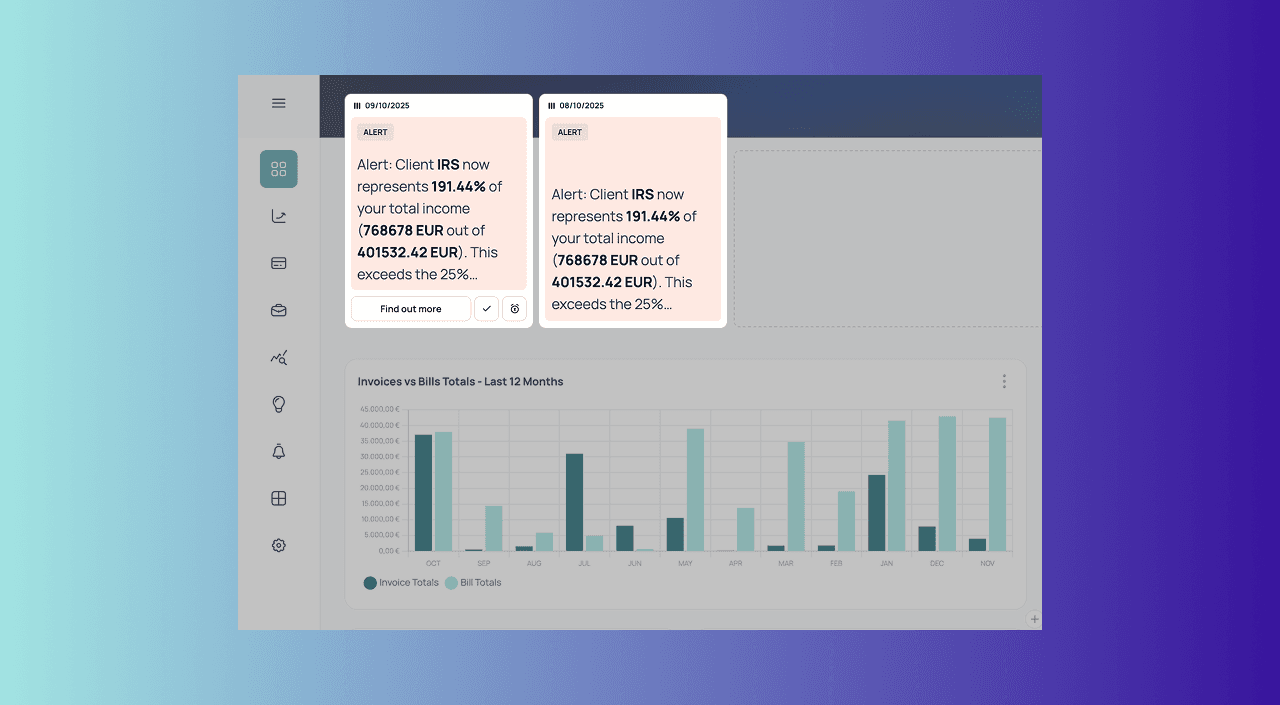
Modern financial tools can help automate these action triggers through intelligent alerting systems. For instance, platforms like Compass AI enable businesses to set up custom alerts based on their specific thresholds — whether that's getting notified when a single customer accounts for more than 30% of total revenue (creating concentration risk), when burn rate exceeds a certain percentage of the budget, or when any critical metric moves outside predetermined boundaries. These automated alerts ensure you catch issues immediately rather than discovering them weeks later during a routine review. The value for businesses is substantial: early detection means more time to respond strategically rather than react in crisis mode.
Finally, remember that financial KPIs don't exist in isolation. They interact and influence each other in important ways. Accelerating revenue growth by lowering prices might improve growth rates, but will damage margins. Reducing CAC by cutting marketing spend might improve efficiency ratios, but kill growth momentum. Review financial KPIs as a system rather than independent numbers, paying attention to ratios like LTV:CAC that capture important relationships. When you see one metric improve dramatically, check whether other metrics are suffering as a result.
How to Choose the Right Financial KPIs for Your Business
Sure, some businesses need the same metrics (margins, net profit, and the basics), but most of the time, each business should be represented by its own set of metrics. The metrics that matter for a bootstrapped services company differ significantly from those critical for a venture-backed SaaS startup. Selecting the right financial KPIs requires understanding your business model, growth stage, and strategic priorities.
If you're running an early-stage startup, your survival depends on understanding your cash position and validating your business model. Focus primarily on Burn Rate and Runway to know how long you can continue operating, don’t forget that cash kills startups, so it’s essential to keep track of it all all times. Track Customer Acquisition Cost even with small numbers to understand unit economics from the start. Monitor Revenue Growth Rate once you’ve got your initial customers down, and validate that your Gross Margin supports a viable business model. At this stage, profitability metrics matter less than proving you have a business worth maintaining & scaling.
Growth-stage companies scaling revenue need different visibility. Your primary success indicator becomes MRR or ARR Growth Rate, showing whether you're achieving the momentum investors expect. The LTV:CAC Ratio ensures your growth remains sustainable and efficient rather than just burning cash for vanity metrics. CAC Payback Period measures the efficiency of your growth investments. Net Revenue Retention shows whether existing customers are expanding their spending with you. Continue tracking Burn Rate and Runway until you achieve profitability, and ensure Gross Margin remains strong and stable as you scale operations.
At the start of this section, we mentioned that each business is unique and that some need to track financial KPIs that reflect their specific operations or industry. Tools like Compass AI provide users with a few different ways of managing their metrics. First, users can create custom metrics by interacting with the AI Assistant. This assistant works alongside the user to extrapolate data from relevant sources, create and visualize their metric through a widget, and attach it to their dashboard for tracking. Also available is the “add financial metric” feature, which gives users an added layer of financial comprehension by allowing them to create custom metrics. It takes into account two inputs based on all the available bank/accounting data to create, store, and track a metric, as well as reference a previously established metric when creating a new one. This becomes particularly valuable when you need to track something specific to your business model — whether that's a particular cost ratio, a specialized margin calculation, or a unique efficiency metric that standard dashboards don't offer. Creating custom metrics ensures you're measuring what actually matters to your business rather than forcing your operations into generic templates, or even worse, tracking them manually week in and week out.
Companies that are profitable but cash-constrained face a different challenge entirely. Your accounting shows profit, but you're struggling with actual cash availability. In this situation, Operating Cash Flow becomes your immediate concern, showing whether operations genuinely generate cash. The Cash Conversion Cycle identifies where cash gets trapped in your business operations. Accounts Receivable Turnover helps you improve collection speed and free up working capital. Track Days Sales Outstanding to understand how long customers take to pay you. Monitor Free Cash Flow to know what cash you actually have available for strategic decisions, and keep an eye on your Current Ratio to ensure you can meet short-term obligations.
Mature companies optimizing performance shift their focus toward efficiency and returns. Net Profit Margin shows bottom-line efficiency after all costs. EBITDA Margin indicates operational performance independent of financing decisions. Return on Equity measures the returns you're generating for shareholders. Revenue per Employee reveals operational efficiency and productivity. Free Cash Flow demonstrates your ability to generate discretionary cash. Operating Profit Margin shows core business profitability, and Debt-to-Equity Ratio helps you manage your financial structure and leverage.
The key to choosing the right financial KPIs is keeping your dashboard focused on 5-10 core metrics. Tracking too many creates noise rather than clarity, while tracking too few leaves you blind to important aspects of business health. Make sure you cover the key dimensions of growth, profitability, cash flow, and efficiency, with the specific metrics chosen based on your current priorities and challenges.
The Bottom Line on Financial KPIs
Financial KPIs translate complexity into clarity. They turn abstract concepts like business health and performance into concrete numbers you can track, target, and systematically improve. Whether you're trying to extend runway or just optimize profitability, the right financial KPIs illuminate the path forward and signal when you need to adjust course.
Start with focus rather than trying to track everything at once. Select a few financial KPIs that matter most for your current situation and strategic goals, track them consistently using automated tools wherever possible, and set clear targets based on industry benchmarks adjusted for your specific context. Check up on them during weekly, monthly, or quarterly reviews and be proactive. Plenty of teams have set up a good KPI structure, but the only thing they do is look at the numbers, they don’t extrapolate and turn them into decisions.
To further help yourselves out, we recommend automating as much as possible. This means connecting your accounting software with whatever’s available, your CRM with whatever’s available, and so on. And lastly, not every employee needs to see every metric, but everyone benefits from understanding key indicators of company health, revenue growth, and runway within reason. In the end, the goal of all this tracking and analysis should be to make better, faster decisions with your team, not alone.